8 More Reasons Why Every Kid Should Go To Camp

Why every kid should go to camp: 8 more reasons

  1. Camp helps with mental stimulation
  2. Camp builds resilience. This is a culmination of many of the above benefits. New friendships, confidence, independence, sense of belonging. All of these things contribute to the development of your child as they make strides from being a kid to a strong, considerate, competent adult. kids have opportunities to build resilience by occasionally struggling when they try new activities.
  3. Camp instills appreciation and gratitude. And let’s not forget, time away from home helps kids appreciate home, their parents, their belongings, a meal cooked by mom or dad, and everything else they don’t have at camp.
  4. Camp helps them face challenges and learn the value of hard work. Because they feel safe at camp, youngsters are comfortable taking healthy risks, setting personal goals and realizing their dreams.
  5. Camp builds character. On top of making new friends, campers also develop an appreciation for the qualities required to cultivate and strengthen these relationships. Camp provides children with the core values of a strong, moral individual by teaching them about ethics, honesty, caring, respect and responsibility.
  6. Camp gets them active by encouraging physical activity. Many effectively ban cell phones and computers, so kids can truly take advantage of all summertime has to offer.
  7. Camp is one of the places where you can truly be yourself.
  8. Camp gives wonderful memories for the future. It’s a time of new discoveries that will stay with children long into adulthood.

MBC Compass: Spring 2019: Widji News

Widjiitiwin continues to build meaningful relationships with our Ignite program partners, and we will again be welcoming groups for 5 of our summer weeks. In the ten years of the Ignite program we have hosted 1758 campers and it all started with 30 campers from Malvern!

Summer at Widjiitiwin is taking shape! It’s early May and we have all but our head cook positions filled. The leadership team is made up of some new and returning staff which will create a solid back bone for summer program, while enjoying the energy and ideas that new staff bring with them.

New for 2019

  • SALT for teens (14-17) is now a 4-week program for one session in July. 4 weeks allows us to pack in more content including a more diverse selection of skills and experiences. SALTers will have access to elective focus programming, will engage in a worship project of their own design and have a differentiated learning outcome. Click here for more details.
  • New activities include a 3D archery range and CNC laser etching craft
  • Focus activities; campers will have time slots in their schedule to choose an activity to focus on over several days allowing them to go deeper in progression and explore new options.

Ignite Partnerships
Our five Ignite partnership camps are growing strong and are more than half our summer campers. This year we anticipate up to 320 campers to attend. Pray for us as we work with kids and youth from at risk and marginalized communities.

  • Fresh Air Camp, in partnership with Toronto Police, 42 Division with PC Mark Gray in its 11th summer, expecting 50-60 campers. Dwayne (Joose) Francois is our camp pastor.
  • Escape Camp, our partnership week with Hughson Street Baptist Church in Hamilton, in its 8th summer, expecting 60-70 campers. The team from Hughson Street (Diana, Derek and others) will provide ministry & Bible teaching.
  • Royal City Camp now in its 7th year expecting 60 campers from Church of the City in Guelph. Spencer (Yankee) Adams is the leader and camp pastor.
  • Venture Camp in its 5th year expecting 80 campers through Capstone Community Bible Church. Rob (Sad Sac) Cripps and Andrew (Nemo) Ironside teach the Word and lead the campers with us.
  • Ephraim’s Place Camp, our partnership with Ephraim’s Place in North York, in its 4th year, expecting 50-60 campers. Kesavan Balasingham from Rouge Park Fellowship Church is our camp pastor.

It’s Back to Widjiitiwin this summer as campers will TIME TRAVEL to various adventures in the past and future. We’re excited by the possibilities of time travel and where each week and each day can go. Maybe we’ll travel back to the 1800’s, visit ancient Rome or maybe into the future, the possibilities are endless! What if we could solve the mystery of the theft of the famous Bruno Lisa painting?

Serving Him together,

Mike (Moose) Greenfield                                  Josh (Heyoo) Laverty
General Director                                                 Director
Camp Widjiitiwin                                               Camp Widjiitiwin

www.widjiitiwin.ca
Ambassadors for Christ to children and youth

Cooking with Moose: Apple Fritters

Recipes we use at camp and some from Moose’s family cookbook, “That Tastes Like Home”. Today’s recipe: Apple Fritters

Ingredients

  • 1 egg
  • 1/2 cup sugar
  • 1 cup milk
  • 3 tablespoons orange juice
  • 1 cup apples, finely chopped, unpeeled
  • 1/2 teaspoon vanilla
  • 2 cups self-rising flour *(see below)
  • Hot oil for frying
  • Sifted confectioners’ sugar (or cinnamon & icing sugar blend)

Directions

  • Beat egg and mix in sugar.
  • Slowly stir in milk and orange juice.
  • Stir in apple, vanilla and flour.
  • Drop mixture by teaspoons into hot oil. Fry until brown on both sides, about 3 minutes per side.
  • Drain in colander or on paper towels.
  • Dust with confectioners’ sugar.
  • Enjoy!!

Self-Rising Flour

  • 1 cup all-purpose flour
  • 1 1/2 teaspoons baking powder
  • 1/2 teaspoon salt

Who Do You Say That Jesus Is?

Jesus asked His disciples in Matthew 16 who do the people say that He was. Then He asked who do you say that I am?

Matthew 16:13-20 When Jesus came to the region of Caesarea Philippi, he asked his disciples, “Who do people say the Son of Man is?” They replied, “Some say John the Baptist; others say Elijah; and still others, Jeremiah or one of the prophets.” “But what about you?” he asked. “Who do you say I am?” Simon Peter answered, “You are the Messiah, the Son of the living God.” Jesus replied, “Blessed are you, Simon son of Jonah, for this was not revealed to you by flesh and blood, but by my Father in heaven.

At different times and places, people have made the mistake of attempting to make Jesus fit their narrative, movement, or worldview. People tack on their own perspectives onto Jesus. Today you can hear about:

  • Jesus the moral teacher
  • Jesus the enlightened man
  • Jesus the social reformer
  • Jesus the feminist
  • Jesus the mystic

People did the same in Jesus time. In first century Palestine you could hear about:

  • Jesus the prophet
  • Jesus the healer
  • Jesus the revolutionary
  • Jesus the teacher
  • Jesus the blasphemer

The same Messiah that is prophesied to be a triumphant King, is also prophesied to be a suffering servant. Jesus is both. Putting the emphasis on one to the exclusion of the other caused the people to reject Him completely.

Who Jesus is, is something that each of us must decide for ourselves. Who do you say that Jesus is? 

So We Went to a Marriage Conference & We Need To Talk

On the first weekend of April my wife Elaine and I attended a marriage conference hosted by FamilyLife Canada at the Fairmont Mont-Tremblant. We drove 6 hours to get there and once we settled in to a great king sized room, we went exploring. The hotel was a little out of our league. It was the first time in my life I have ever had valet parking. However, the conference was just what we needed to refresh our relationship. 86 couples gathered to learn from great teachers; Neil & Sharol Josephson, Keith & Sheila Gregoire and Che & Shireen Spencer.

We worked through a variety of lessons and activities with an 85 page workbook (his & hers versions). There were very actionable lessons with work on your own then share with spouse sections plus several couples’ projects including writing a love letter (we were both teary). Saturday evening was date night! We had a delicious dinner and went back to our room and played Carcassonne.

The weekend focus was Marriage Oneness

  • Relational Oneness – close
  • Emotional Oneness – connected
  • Physical Oneness – content
  • Spiritual Oneness – complete
  • 5 Things Your Spouse Wants You To Know (men & women separately)

Some great quotes:

  • Great marriages don’t just happen
  • Sea otters hold paws when they sleep so they stay together
  • A great love isn’t built from big promises, but from small choices
  • Conflict is inevitable. In the midst of a conflict believe we want the best for each other 
  • Not every touch leads to a touchdown
  • Nothing predicts a couple’s future better than how they retell their past
  • Oneness with God, as in marriage, grows over a lifetime
  • Do a good thing now and do a better thing tomorrow. And soon you will be doing a great thing. Seth Godin

So, Elaine & I went to a marriage conference & we did talk! And it was good! We both learned and laughed and ate good food. We won a book and a trip back for another one. 

Knowing is NOT Enough, We Must Apply

Lots of us do a lot of learning through reading, play, podcasts, books, online sources, webinars, sermons, etc. The problem is that if we don’t do something with our newfound knowledge we lose the value of what we have learned. It has been said that if we don’t make a decision of what to do with new information within three days, we most likely will not do anything. I think that’s one reason why New Year’s resolutions often fail. 

  • Bruce Lee says, “Knowing is not enough, we must apply. Willing is not enough, we must do”.
  • “Learning occurs at the point of application.” Barry Pettit 
  • “Do or do not, there is no try.” Yoda
  • “Just do it.” Nike

James 1:22-25 Do not merely listen to the word, and so deceive yourselves. Do what it says. Anyone who listens to the word but does not do what it says is like someone who looks at his face in a mirror and, after looking at himself, goes away and immediately forgets what he looks like. But whoever looks intently into the perfect law that gives freedom, and continues in it—not forgetting what they have heard, but doing it—they will be blessed in what they do. (NIV)

What information do you have that you have not yet acted upon?

What has your Bible reading revealed that you have not acted on?

What sin do you continue to do that you know is wrong and may be controlling you? 

Today you can start changing your actions. You may fail, but then start again. Don’t give up!!

7 Reasons for 7 Year Olds to Go to Camp

Some would say that 7 is too young to go to camp. Here are 7 reasons why we think 7 just the right age!

  1. They will develop independence & empowerment. At camp, children learn the responsibility of making their own decisions with the safety net of insightful camp staff in a safe environment. Kids are empowered at camp to take care of themselves, with guidance from cabin leaders. Being away from home for the first time can be scary but the more days at camp you spend, the more independent you become. Independence leads confidence to try new activities and meet new friends. 
  2. They will learn new skills as they try new activities. Summer camp is full of opportunities for skill building. Kids live in cabin groups and these cabin groups live, eat, attend activities and play games as a group. By living and playing together, campers learn to work together to conquer challenges that comes their way.
  3. They will make new friends. This offers a unique opportunity for your child to branch out in the friends he or she has. Free from the social pressures at school, camp encourages kids to relax and make friends easily. They’ll be in a cabin with 7 other campers and two great cabin leaders. 
  4. They will learn social skills. Getting away from their devices and other screen time, they will come face to face with other campers and staff and want to spent time with them. Not having an escape will help them become better conversationalists. So much better than texting from across the room. 
  5. They will have a lot of fun. What better reason to go to camp than to have fun. Kids should be able to let off steam in an environment that is safe and accepting while enjoying everything. We have over 20 activities plus all camp games and other programmed events through the week. 
  6. They will get a break from their routine and technology. Camp helps kids learn how to be kids again. In this technology-filled world, camps cut back on distractions. Kids can get up and get moving through a variety of physical activities! And in Muskoka too! 
  7. They will grow in self-confidence and self-esteem. When kids are at camp, they don’t have mom and dad there to help them approach people and make connections. They get to me themselves and in the trying of new activities figure out things they’re good at. 

Bonus reason: They will have great role models in the staff who love working with kids and will lead them. Cabin leaders, directors and program staff provide a mentoring that cannot be found anywhere else. Campers look up to our staff as role models. The people you meet at camp become like a second family, who teach you new skills, and provide constant support and encouragement.

Cooking with Moose: Southern Biscuits

Recipes we use at camp and some from Moose’s family cookbook, “That Tastes Like Home”. Today’s recipe: Southern Biscuits

Ingredients

  • 5 cups Flour
  • ½ cups White sugar
  • 3 tbsp. Baking powder
  • 1½ cups Margarine
  • 2 cups Milk (cold)
  • 2 cups Cheese (cheddar shredded)

Directions

  • Mix flour, sugar and baking powder
  • Cut in margarine and mix until crumbly
  • Add milk and make dough
  • Add cheese
  • Scoop into muffin pans that have been sprayed well with pan spray
  • Bake in 400 F oven for 15 minutes or until golden brown

Notes:

  • Yields 2 dozen

Rock Picking & Forgiveness

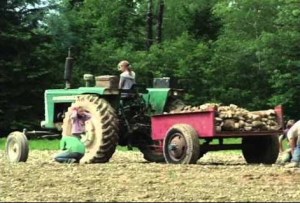
When I worked at Camp Ambassador in the spring of 1982, I had to pick rocks from the fields before planting the grains of oats and wheat that would feed the horses over the winter. Once the rocks were picked up and tossed onto the hay wagon or stone boat, we would be dump them along on of the rock walls along the edge of a field or in a swampy area. It was hard, back breaking work and long days. It was a privilege to get to be the one to drive the tractor, even if it was just 25 feet ahead and then get back off to help pick more rocks.

As an aside, Burt Elliott was the best tractor driver there was at camp. He could do figure 8’s with a wagon loaded with campers and staff like no one I ever knew. I never did attain to his level of skill. 

The reason the rocks had to be picked very spring was because the frost in the winter season pushes up small and large stones and rocks that need to be removed before planting or it will wreck machinery in planting season. And the harvest will be diminished. Is not my life like a field that every spring needs to be picked of rocks? 

My sin needs to be dealt with, the pride in me, before the harvest will be great. Each year new rocks, like sins or issues I thought were dealt with years ago come back to the surface to be dealt with again. They get picked or pulled out and dumped, but instead of a big pile or a wall along the edge of a field, I get to leave them at the feet of Jesus and ask for forgiveness. 

Don’t let your field fill up with rocks. Deal with your sin and keep a short account of your sin with God. Ask for and receive His forgiveness.

Staffing, How Widji Builds its Team

As any manager knows, building a team and hiring staff every year can be exhausting work. There are countless models to follow, and countless considerations that can pile up and, if not careful, overwhelm a person with decisions.

To give an idea of what hiring looks like for this organization, here’s a couple of numbers:

  • MBC and Widjiitiwin hire around 165 seasonal staff every spring & summer
  • Widjiitiwin has a team of approximately 50 staff working at any given time.
  • To have a full team working requires approximately 60-70 workers and volunteers
  • 80-90 – the number of applications we typically see for Widjiitiwin each year
  • 39 – The number of shows we do as a team, some job fairs, some camp fairs

To put these numbers into perspective, remember that we try to interview every applicant. In 3 years, I can think of only 2-3 applications that did not result in an interview, and that is often due to other opportunities coming up.

What does Widjiitiwin look for?

Great question, and in case you’re taking notes and anxiously anticipating the secret to getting a job at Widji, sorry to disappoint you, but there is no one thing. There is no secret sauce or magical quality that makes one staff member a sure hire and another a maybe; this is because there are many things that stand out and not always for the better. To make it easier for parents and staff to understand our process, I’ll outline some of it below; but only some of it because it’s too long otherwise.

Step 1. Applicants are encouraged to read the information on our team found here. They can learn about pay, timelines, what the job descriptions are and finally apply. *It is critical that people are concise and accurate in making their profile with correct birth date and email address.

Step 2. We set aside blocks of time and invite the staff to choose when they can interview. Interviews go to the first to respond.

Step 3. We have established an interviewing process that results in a debrief page that uses common language so the whole team can reflect on the same elements of a person’s character. Here are some sample questions:

Prefacing the interview, we like to begin the conversation stating that we won’t ask anything we’re not comfortable answering ourselves, and if anything makes you uncomfortable we want to know so we can change the question or talk about something else.
Q.1 What is the most important thing at camp for the role to which you have applied?”

The answer to this question is Safety. People cannot go anywhere without a start, and the starting point for campers is that they are safe: Emotionally, Physically and Socially

Q.2 Define for me a man/woman of God.”

There are many correct and wrong answers to this, but what we are most interested in observing is what the person’s value structure is based on. Where do they get this definition and to what are they aspiring toward?

Q.3 Tell me about yourself”

Again, lots of good answers here, but what we look for is how people define themselves, what is important to them and the language used in the response is important to observe. 

Once through the Interview, our debrief form use measurements to assess teamwork, personality and fit, also allowing the interviewer an opportunity to express comments.

With all the paperwork filled out, we then meet as a team and look for matches, dynamic duos and trios per say. Working on teams in the past, we’ve learned that 2 people can do more work than 3 individuals when they are dynamically motivated, engaged and inspired together. If we can identify these pairs early on, then this is the beginning of identifying where we will put the strongest matches on our team.

With our dynamic duos starting to make up the team, we then have a very difficult decision to make: To whom do we say no? We can’t hire everyone, even good candidates are rejected. Sometimes good staff are offered work that they decide they don’t want to do and then we have to find someone else. This makes the process dynamic, and at times prolonged while we assess multiple candidates.

Training

This is a topic we don’t get asked about very often; that may be because we call it “Development”. We feel that this distinguishes our objectives. You can train an animal and a plant, what we want to do is develop the character and capacity of our staff into a more competent and responsible staff member. This includes skills, and also behaviour, but also comprehension and outlook.

Directors, Leadership and Front-line

Directors are responsible for the decision making on a high level around camp. People report to them and they are responsible for outcome and experience. We seek out directors and sometimes they come to us. These roles include Program, Ministry, Waterfront and SALT director.

Leadership staff provide direct supervision to front-line staff. Some of these staff provide support to the cabin leaders and oversight on things like discipline and devotional times. We have engaged the CMHA to provide Mental Health First Aid training to specific leadership, providing competent care for special cases and the well-being of our staff. Other leadership staff give immediate oversight to activities and games. These staff focus on the camper experience and what we call Program.

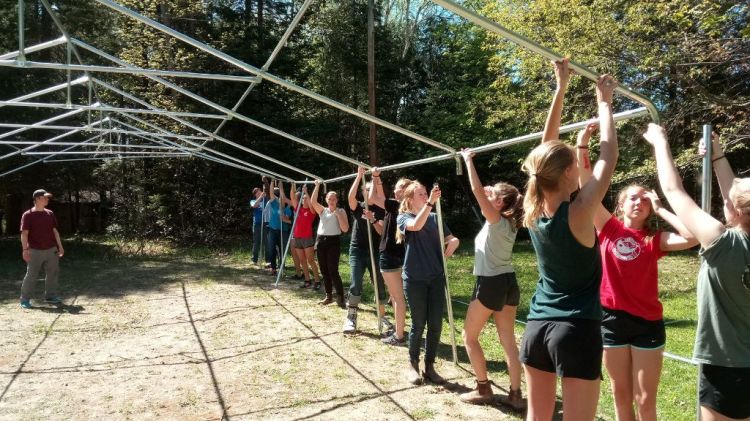
Front-line staff deal directly with campers and facility. This would include custodial duties and cleaning, cabin leading and dishes. These positions are in many ways the most critical roles as camper care is what we’re all working towards. These staff receive hands-on instruction in their activity areas from certified and experienced instructors. Workshops also include coping with stress, diffusing conflict, Biblical training and facilitation.

It is extremely hard for us to make these decisions when a lot of our applicants are valued friends and past campers/staff, and a lot of prayer is involved in pursuing what God would do with this ministry. Through all of it we appeal to the Holy Spirit to guide us with wisdom, and view this place as something we steward – This place doesn’t belong to us, but continues by God’s grace as long as he provides what is needed to do this work. We aren’t perfect, and must at times take a step away from things to let God work through us.

Heyoo