You Never Learn Anything While You’re Talking

“You never learn anything while you’re talking,” Joan Batura.

I borrowed this title from Paul Batura’s article about his mom’s recipe box. Side note: I have my mom’s and grandma’s recipes. Some of which I now make and deliver to my mom in pint jars. 

Listen twice as much as you talk. It would seem that since God designed us with two ears and only one mouth he meant for us to listen more than talk. James 1:19 says, “Know this, my beloved brothers: let every person be quick to hear, slow to speak, slow to anger.” We have two ears and one mouth so that we can listen twice as much as we speak – Epictetus. 

Most people don’t listen while they are in conversation, they are preparing for what they are going to say next. “The biggest communication problem is we do not listen to understand. We listen to reply,” Stephen Covey. Instead, we should be practicing active listening where you are concentrating intensely on what the other person has to say and seeking to understand it. In order to be a good listener, we first need to learn how to be silent. That includes, not thinking about how you’re going to reply when another person is talking. 

Even though you might have a lot to say, sometimes it’s best not to respond. In silence, without distractions, that’s when people feel respected and appreciated. People don’t care about how much you know, until they know how much you care.

The Bible talks a lot about the use of our tongues, the words we use and the way we say them. Here are some great examples.

James 3:5-8 talks about the tongue saying – So also the tongue is a small member, yet it boasts of great things. How great a forest is set ablaze by such a small fire! And the tongue is a fire, a world of unrighteousness. The tongue is set among our members, staining the whole body, setting on fire the entire course of life, and set on fire by hell. For every kind of beast and bird, of reptile and sea creature, can be tamed and has been tamed by mankind, but no human being can tame the tongue. It is a restless evil, full of deadly poison. 

Proverbs 12:18 – “There is one whose rash words are like sword thrusts, but the tongue of the wise brings healing.” As children of God, our tongues have a lot of power. Proverbs 18:21 confirms this by saying, “Death and life are in the power of the tongue, and those who love it will eat its fruits.”

Proverbs 15:1 A gentle answer turns away wrath, but a harsh word stirs up anger. The tongue of the wise commends knowledge, but the mouth of the fool gushes folly.

Psalm 39:1 of David, I said, “I will watch my ways and keep my tongue from sin; I will put a muzzle on my mouth while in the presence of the wicked.

Proverbs 18:4 A person’s words can be life-giving water; words of true wisdom are as refreshing as a bubbling brook.

Proverbs 13:3 Whoever guards his mouth preserves his life; he who opens wide his lips comes to ruin.

Forrest Gump’s Mama always said, “God gave you two ears and one mouth for a good reason. He meant for you to listen twice as much as you talk.” 

Jesus Returns to Nazareth

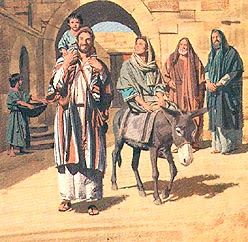
Jesus, Joseph and Mary return to NazarethReturn to Nazareth

by Ray Fowler (used with permission) 

This is the capstone of the Christmas story. Jesus was a Nazarene! He lived in humility, he was raised in obscurity, he suffered contempt – all so that we could be brought into the family of God. What a wonderful Savior!

Even though Advent and Christmas are over, we still have one passage left in our Christmas story from Matthew. When we last left Joseph and Mary, they were still living in Egypt awaiting further instructions. King Herod had tried to kill Jesus, but God had told Joseph to stay in Egypt until God told him otherwise. So there they were, living in Egypt, waiting for a fresh word from the Lord. And that word finally came in Matthew 2:19-23.

This final passage in Matthew is crucial to understanding what happened to Jesus after his birth. Remember, when Jesus was born in Bethlehem, there was a star in the sky for all to see. Magi from the east came to worship him. Herod wanted to kill him. All of Jerusalem knew that he had been born. This child was a celebrity! Surely with such miraculous and tumultuous beginnings, Jesus was destined to grow up famous.

Now, we said each of these places associated with Christ had an important Biblical meaning. Jerusalem was the center of worship and power. Bethlehem was the birthplace of the Messiah. Egypt was the place of bondage and slavery. Israel was the land of promise. So what was Nazareth?

Nazareth was nothing! It is not even mentioned in the Old Testament. It is a tiny town located in the hills of Galilee about 80 miles north of Jerusalem. No one important ever came from Nazareth. No great events ever took place there. No great buildings adorned its landscape. There was no downtown Nazareth. It was sticksville. It was poor people living in poor surroundings surrounded by poor circumstances. And it is exactly where God chose for Jesus to be raised.

Nazareth stood for three things in Jesus’ life: humility, obscurity and contempt. First of all, humility. Jesus was born in humble surroundings, and he was raised in humble surroundings. He was born King of the Jews! He should have been raised in a palace in Jerusalem, but instead he was raised in the humble town of Nazareth. Jesus was raised in humility.

Secondly, Nazareth stood for obscurity. Jesus had a high-profile birth in Bethlehem, but he lived a low-profile life in Nazareth. For thirty years Jesus would labor in obscurity as the son of a carpenter. For thirty years the Son of God who created the universe would work and eat and play in a small town on the corner of nowhere. Jesus was raised in obscurity.

Thirdly, Nazareth stood for contempt. When Jesus finally began his public ministry and people found out he was from Nazareth, they were not impressed. Trust me, you did not want Nazareth on your resume. When Philip told Nathanael he had found Jesus of Nazareth, Nathanael responded with utter contempt: “Nazareth! Can anything good come from there?” Nathanael asked. (John 1:46) Jesus was raised in a place that stood for humility, obscurity and contempt.

So why did God do this? Why did God choose Nazareth for Jesus’ hometown? We find the answer in the second half of verse 23: So was fulfilled what was said through the prophets: “He will be called a Nazarene.” (Matthew 2:23b) It was to fulfill Scripture.

Now Jesus was most certainly called a Nazarene. Throughout his life he was not known as Jesus of Bethlehem or Jesus of Jerusalem but rather Jesus of Nazareth. When Jesus died on the cross, Pilate put up a sign saying: “Jesus of Nazareth, The King of the Jews.” (John 19:19) When Jesus rose from the dead and ascended to heaven, the apostles continued to preach him as Jesus of Nazareth, crucified and raised from the dead. (Acts 4:10) And when Jesus spoke to Paul from heaven, he even took the name upon his own lips when he said, “I am Jesus of Nazareth, whom you are persecuting.” (Acts 22:8)

Foretold by the prophets (Judges 13:5; Isaiah 11:1; Jeremiah 23:5; Isaiah 53:2-3). So Jesus was most certainly called a Nazarene. He was identified with Nazareth in his life, death, resurrection and ascension. He would forever be associated with Nazareth. The question becomes, where in the Old Testament was this prophesied? Because you might remember we said earlier that the town of Nazareth is not even mentioned in the Old Testament. And indeed this particular phrase: “He will be called a Nazarene,” never appears in Old Testament Scripture. So what prophecy is Matthew referring to?

Some people suggest that this was an unwritten prophecy that had been passed down verbally, but I don’t find that convincing. Matthew always seeks to ground the life of Jesus in Scripture.

Notice that Matthew does do something differently with this quote. Usually when he quotes the Old Testament he says, “This was to fulfill what the prophet said,” where he uses the singular word “prophet,” or sometimes he even names the prophet, such as “This is what the prophet Isaiah said.” But here the reference is much more general: “So was fulfilled what was said through the prophets.” Notice how he uses word “prophets” here; he uses the plural word. And so Matthew is not thinking so much of one specific prophecy in Scripture as a general revelation about Jesus that was present in a number of prophecies in the Old Testament.

So what were these prophecies? Some people point to the similarity between the words “Nazareth” and “Nazirite” and see in these words a fulfillment of the word originally spoken about Samson in Judges 13:5: “You will conceive and give birth to a son … the boy is to be a Nazirite, set apart to God from birth, and he will begin the deliverance of Israel from the hands of the Philistines.” (Judges 13:5) Jesus was not a Nazirite, but he was certainly set apart to God from birth, and he worked a much greater deliverance than Samson.

Others see a similarity between the word “Nazareth” and the Hebrew word for “sprout” or “branch.” So Matthew may have been thinking about those prophecies which spoke of the Messiah as a Branch. There are six of these prophecies in the Old Testament – two in Isaiah, two in Jeremiah, and two in Zechariah. (Isaiah 4:2, 11:1; Jeremiah 23:5, 33:15; Zechariah 3:8, 6:13) Let me share just two of them with you here. Isaiah 11:1 – “A shoot will come up from the stump of Jesse; from his roots a Branch will bear fruit.” (Isaiah 11:1) And Jeremiah 23:5 – “The days are coming,” declares the Lord, “when I will raise up to David a righteous Branch, a King who will reign wisely and do what is just and right in the land.” (Jeremiah 23:5)

And then there are those prophecies that spoke of Jesus coming quietly and humbly. I think of Zechariah 9:9: “See, your king comes to you, righteous and having salvation, gentle and riding on a donkey.” Or there is Isaiah 53 which speaks not only of humility but also of derision and contempt: “He grew up before him like a tender shoot, and like a root out of dry ground. He had no beauty or majesty to attract us to him, nothing in his appearance that we should desire him. He was despised and rejected by men, a man of sorrows, and familiar with suffering.” (Isaiah 53:2-3)

So what did these prophecies tell us? That the Messiah would come humbly and quietly. Like a branch or a shoot out of dry ground there would be nothing remarkable about him to draw our attention to him. In fact we would treat him with contempt, as if he were less than nothing. In other words, we would treat him exactly like someone who was raised in the dirt town of Nazareth.

Jesus came not only to be with us but to become like us. And the beautiful truth we learn from these verses is that Jesus came not only to be with us but to become like us. There are two prophetic names given to Jesus here in Matthew – one at the end of chapter one, and another here at the end of chapter two. At the end of chapter one Jesus is called “Emmanuel” which means “God with us.” (Matthew 1:23) And at the end of chapter two he is called a Nazarene, which means he has become one like us. (Matthew 2:23)

“God with us” is a beautiful truth, but God can be with us and still separate from us. God was with Israel in the wilderness, but he was not like Israel. He was highly exalted in the flame and the cloud, and he dwelt in the tabernacle apart from men.

But the beautiful truth of this passage is that God is not only with us, he became like us. He became one of us. Jesus was God in the flesh, incognito, undercover. There was nothing about his appearance to signal to you that he was God – no shimmering halo, no other-worldly glow. His feet walked in the dust, and his hands gathered blisters.

He was an ordinary person like you and me. He was raised in an ordinary town, and lived an ordinary life, far from the power center of Jerusalem, far from his birthplace in Bethlehem. He lived in obscurity. He was not known as Jesus of Bethlehem, which would have had Messianic implications, but Jesus of Nazareth, a term filled with contempt. He made himself nothing and became a servant for us. He was a man of sorrows, familiar with suffering. He who was born a King was raised a Nazarene.

And as Jesus lived in humility, so he died in humility. He humbled himself and become obedient to death, even death on a cross. The meaning of the Nazarene passage is that Jesus became a nobody so you could be somebody. Jesus became like us so we could become like him. He made himself of no reputation, so that you could be known as a child of God – holy and righteous, destined for glory.

Thank God for Jesus the Nazarene!

© Ray Fowler. Website: http://www.rayfowler.org

Find the full text at www.rayfowler.org/sermons/matthew/the-nazarene

The Apostles’ Creed

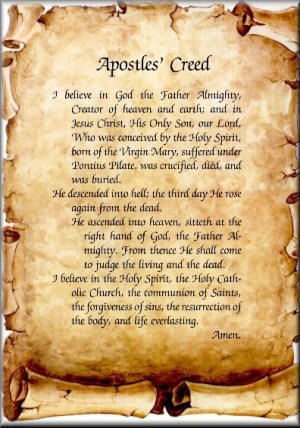
Apostles’ Creed

I remember reciting the Apostles’ Creed a kid and youth in church. We have gotten away from this type of reading or recitation and I think we have lost something in our modern churches. Many Christians throughout history have used the Apostles’ Creed as a proclamation of their own faith. 

The Apostles’ Creed was composed as a direct response to heresy in defense of the gospel and the Christian faith. It was intended to articulate the essentials of the Christian faith against a backdrop of heresy, specifically Gnosticism which denied the divine creation, the incarnation of Christ, the deity of Christ and salvation by faith in Christ alone.

I have also included the Nicene Creed and This I Believe (The Creed) by Hillsong Worship below. 

The Apostles’ Creed

I believe in God, the Father almighty,
     creator of heaven and earth.

I believe in Jesus Christ, his only Son, our Lord,
     who was conceived by the Holy Spirit
     and born of the virgin Mary.
     He suffered under Pontius Pilate,
     was crucified, died, and was buried;
     he descended to the dead.
     The third day he rose again from the dead.
     He ascended to heaven
     and is seated at the right hand of God the Father almighty.
     From there he will come to judge the living and the dead.

I believe in the Holy Spirit,
     the holy catholic church,
     the communion of saints,
     the forgiveness of sins,
     the resurrection of the body,
     and the life everlasting. Amen.

A modern version is in the song, This I Believe (The Creed) by Hillsong Worship 

Our Father everlasting
The all creating One
God Almighty
Through Your Holy Spirit
Conceiving Christ the Son
Jesus our Saviour

I believe in God our Father
I believe in Christ the Son
I believe in the Holy Spirit
Our God is three in One
I believe in the resurrection
That we will rise again
For I believe
In the Name of Jesus

Our Judge and our Defender
Suffered and crucified
Forgiveness is in You
Descended into darkness
You rose in glorious life
Forever seated high

I believe in You
I believe You rose again
I believe that Jesus Christ is Lord

I believe in life eternal
I believe in the virgin birth
I believe in the saints’ communion
And in Your holy Church
I believe in the resurrection
When Jesus comes again
For I believe in the Name of Jesus

Songwriters: Crocker Matthew Philip / Fielding Benjamin David
This I Believe (The Creed) (Alternate Version/Live) lyrics © Hillsong Music Publishing Australia

Nicene Creed 

I believe in one God,
the Father almighty,
maker of heaven and earth,
of all things visible and invisible.

I believe in one Lord Jesus Christ,
the Only Begotten Son of God,
born of the Father before all ages.
God from God, Light from Light,
true God from true God,
begotten, not made, consubstantial with the Father;
through him all things were made.
For us men and for our salvation
he came down from heaven,

and by the Holy Spirit was incarnate of the Virgin Mary,
and became man.

For our sake he was crucified under Pontius Pilate,
he suffered death and was buried,
and rose again on the third day
in accordance with the Scriptures.
He ascended into heaven
and is seated at the right hand of the Father.
He will come again in glory
to judge the living and the dead
and his kingdom will have no end.

I believe in the Holy Spirit, the Lord, the giver of life,
who proceeds from the Father and the Son,
who with the Father and the Son is adored and glorified,
who has spoken through the prophets.

I believe in one, holy, catholic and apostolic Church.
I confess one Baptism for the forgiveness of sins
and I look forward to the resurrection of the dead
and the life of the world to come. Amen. 

How Camp Builds Resilience in Kids & Youth

resilienceThis appeared in a recent blog article by the Association of Christian Schools International called, “13 Ways to Build Resilience In Your Children“. When you can’t write it better, use the experts. 

Welcome to 2021! Now What?

If you want to hear God laugh, tell Him your plans.2020 was a year for the history books. And not one I’m sure any of us wants to repeat it. We no sooner got 2020 started than we had to change EVERYTHNG we knew about how to work from home, live, shop, wear masks, sanitize everything, communicate and wash our hands (just like grandma told us). Zoom even became a household word, a verb, a place to meet and a communication tool (what it was designed to be). 

Storytime with Moose

Princess Charity's Courageous Heart

As part of an MBC initiative, “MBC Storytime“, Moose and Heyoo read stories leading up to Christmas 2020.  Here, Moose reads the book Princess Charity’s Courageous Heart, based on the parable of the Good Samaritan (Luke 10:25-37). Princess Charity’s Courageous Heart was written by Jeanna Young & Jacqueline Kinney Johnson with illustrator, Omar Aranda.

It was mostly fun to do and I hope you enjoy it. For Olivia! Moose 

Advent; Anticipating the Coming of Christmas

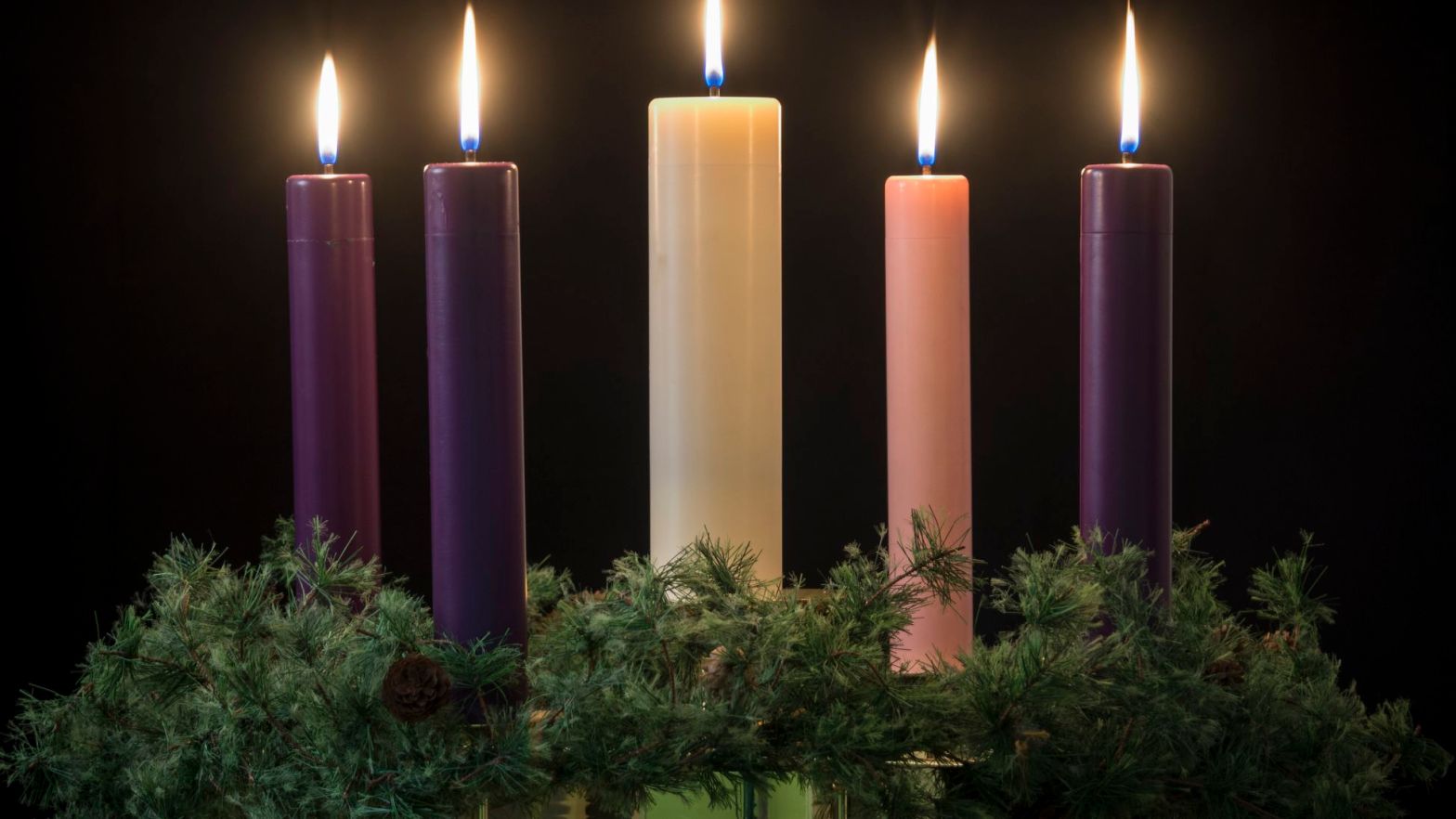
advent candlesAs a kid I grew up in a main line denomination and I still remember some of the liturgical portions of those church services. I also remember that there were seasons marked out on our church calendar. Lent and Advent are two prominent ones I remember. As we approach Christmas this year, let’s talk about the Advent season that we are currently in. I am reminded that Advent candles shine brightly in the midst of darkness, symbolizing and remind us that Jesus came as Light into our dark world. 

Advent means ‘coming’ in Latin. It could also mean “arrival”. Advent involves four candles around the wreath. A new candle is lit on each of the four Sundays before Christmas. This is the coming of Jesus, the Messiah, into the world. Christians use the four Sundays (weeks of Advent) leading up to Christmas to prepare and remember the real meaning of Christmas. That being the birth of Christ. 

The Candle of Hope – Like the prophets in the Old Testament, we hope for a Messiah to save us from the sin in the world (Isaiah 9:6-7). We anticipate our Saviour’s arrival. This candle assures us we can have hope that God will fulfill the prophecies declared in the Old Testament about Jesus. Hope doesn’t disappoint us (Romans 5:5). We hope Jesus will return soon to this dark and despairing world. 

The Candle of Peace – One of the hallmarks of the Christmas story is when the angels appear to the shepherds and proclaim, “Peace on earth,” in Luke 2:14. Jesus brought about peace, in the most unexpected ways, when he arrived. Jesus brings us peace in a number of ways. First, he gives us inner peace. Because of his work on the cross, we have a chance to receive salvation and be indwelled by the Holy Spirit (John 14:27). Not only do we have the peace that comes from our assurance of salvation, but we also have the peace of mind knowing God will heal this broken world and will come again.

Second, we have peace with others. We put aside our differences (Galatians 3:28), especially with other believers, because we belong to the same family. We have the same purpose: to let others know about the peace of Christ. The Hebrew word for peace: Shalom, goes far beyond not fighting with others or peace as we know it. Shalom is how things are meant to be: a slice of heaven. 

The Candle of Joy – this candle reflects the joy that comes through Jesus’ arrival, and through the salvation he has gifted us. Christians may wonder why the church decided to make this particular candle a different color than the others. This week celebrates the joy of Christ’s coming to earth. It is also known as the Shepherd Candle to highlight the joy the shepherds experienced when they received the good news about Christ’s birth (Luke 2:8-20). During the middle of the night, the darkest time, the shepherds encountered angels.

The Candle of Love – We know that virtues such as love, hope, peace, joy, and faith are important in the Christmas story as well as in our daily walk with Christ. Love plays a vital role in the Christmas story. Because of Joseph’s love for Mary, he didn’t stone her when he found out she was pregnant with what he thought was a child out of wedlock with another man (Matthew 1:18-19). Mary has a natural motherly love for Jesus, and ultimately, we see God’s love for everyone by sending his son for us (John 3:16). Jesus focused on preaching love throughout his ministry.

Two of his greatest commands involve love: Love God, love your neighbor (Matthew 22:36-40). Love is the greatest of all the virtues on the Advent wreath and encompasses Jesus’ entire purpose for being on earth (1 Corinthians 13:13). 

The Christ Candle – In addition to the love candle, we light the white candle at the center of the wreath on Christmas Eve or Christmas Day. The white tends to symbolize Christ’s purity, showing Christ’s righteousness and blamelessness. The Christ candle represents Christ and the role he plays in the Christmas story. Jesus brought light into the world through his arrival on earth as a baby. 

We can’t leave the Advent season without a reminder that the story doesn’t end at Christmas. We know that in Jesus’ life on earth that Christmas leads to Easter, to His death on the cross. Without Easter, Christmas is nothing more than carols, turkey, cookies, pie and a nap.

Have Merry Christmas & see you at Easter. 

Ripples of Caring and Kindness

A stone dropped in a pond generates waves in a beautiful changing pattern, a rippling ring radiating outward from a centre that gradually returns to quietude. The expanding ring is called a wave packet. Individual waves travel at different speeds, the long ones going fastest and the shortest ones slowest. 

Even the smallest act of caring for another person is like a drop of water – it will make ripples throughout the entire pond.” Jessy and Bryan Matteo

Ripples of caring and kindness can go a long way out from us. Lots of ties we don’t see the results of those ripples as they affect the lives of the people we connect with, but it also goes out and touches the people they connect with. The influence of our caring and kindness, our example, is multiplied. 

Here’s another way to look at it. One of my favourite quotes is about apple seeds. They are pretty small, but have great potential and possibilities.  “You can always cut open the apple and find out how many seeds are inside, but there’s no way you can cut the seed and find out how many apples are in it.” 

Jesus told a parable in Matthew 25:34-40 about the sheep and the goats. In it he says, “Then the King will say to those on his right, ‘Come, you who are blessed by my Father; take your inheritance, the kingdom prepared for you since the creation of the world. For I was hungry and you gave me something to eat, I was thirsty and you gave me something to drink, I was a stranger and you invited me in, I needed clothes and you clothed me, I was sick and you looked after me, I was in prison and you came to visit me.’ “Then the righteous will answer him, ‘Lord, when did we see you hungry and feed you, or thirsty and give you something to drink? When did we see you a stranger and invite you in, or needing clothes and clothe you? When did we see you sick or in prison and go to visit you?’ “The King will reply, ‘Truly I tell you, whatever you did for one of the least of these brothers and sisters of mine, you did for me.’

And again in Matthew 10:42 he says, “And if anyone gives even a cup of cold water to one of these little ones who is my disciple, truly I tell you, that person will certainly not lose their reward.” 

The Ripple Effect” Poem

Drop a pebble in the water, just a splash and it is gone, but there are half-a-hundred ripples, circling on and on and on.
Spreading from the center, flowing onward to the sea, and there is no way of telling, where the end is going to be.
Drop a word of cheer and kindness, just a splash and it is gone, but there are half a-hundred ripples circling on and on and on.
Bearing hope and joy and comfort, on each splashing, dashing wave – til you wouldn’t believe the volume, of the one kind word you gave.
Drop a word of cheer and kindness, in a minute you forget,
But there is gladness still a-swelling, and there’s joy a-circling yet.
For you’ve rolled a wave of comfort, whose sweet music can be heard, over miles and miles of water all around the world, by just dropping… One Kind Word

Building Resilience in Campers

At Widjiitiwin, campers and staff often get scrapes, bumps and bruises. Sometimes they get sick for a day or two. Sometimes they fall and hit their head, arm or butt. 

Camp is far and away the safest place for these things to happen to children. Because children are away from home, they adapt and learn the skills needed to deal with relatively minor adversities of life. Of course, they do this with the warm and thoughtful assistance of caring staff.

When children at camp face a bit of diversity, the staff at camp – cabin leaders, the chiefs, program staff, directors, even kitchen and service staff – are all here to pick them up, help with their adaptation skills and move on.

What better place to learn to handle the trials and tribulations of daily life is there than camp? We can’t think of any. 

Camp has this incredible way of impacting so many people in so many different ways. When campers think they are spending the summer simply having fun, they often have no idea the character, social skills and self-confidence they are building at the same time. Camp helps foster empathy toward others. It can make them responsible, kind and brave. It also makes them resilient.

Campers are pushed (gently) out of their comfort zones every day when they are at camp. They are encouraged to try new things. Sometimes they make mistakes, but campers are taught that the only time you fail is when you stop trying. Because of this attitude, campers learn to pick themselves up and brush themselves off. They learn to face adversity — a skill they carry with them for the rest of their lives. At SALT we call it “failing with dignity“.

Cabin leaders teach campers that being tough doesn’t mean you’re void of emotions. You can be brave and scared at the same time. It’s okay to cry, feel frustrated, even walk away if you need a break (as long as the cabin leader knows where they are). It’s okay to ask for help. Campers face different kinds of challenges very day, all summer, from attempting the ropes course, swimming for the first time, conquering stage fright or just introducing themselves to new people. But every time they face a fear, even if they struggle, they become a little more resilient each time. They learn to embrace stepping out of their comfort zone.

Self-confidence is not something that comes naturally to all campers, but it is something they develop after a summer at camp. They naturally begin to see themselves as capable, smart, brave, athletic, kind, interesting and strong. It sets a solid foundation for the people they are becoming.

Camp helps mold campers into confident and resilient individuals, all disguised as the best summer they’ve ever had.

Borrowed in part from Camp Laurel

Have You Been to God’s Night School?

PrayHave you been to God’s night school? You know you have. I certainly have. Too many times to count. It’s the middle of the night and for seemingly no good reason there you are, lying WIDE AWAKE. Even if you’ve had a sleeping pill, fan on, window open or warm milk (I never did understand that one) and all the other perfect sleeping conditions, you just CAN’T. FALL. BACK. ASLEEP. Whatever is occupying your subconscious mind wakes you up. And keeps you awake even after using the bathroom. You try listening to music, tossing and turning, changing pillows, reading, making notes (that are, of course, unintelligible in the morning), blankets up, blankets down, switch side to side, 87 different positions and by the time you have done all of that it finally occurs to you that maybe, just maybe I should pray. 

Over the last few weeks my sleep has been disturbed many nights. I worry. I always have. I can tell you that I have an average of 12.7 nights a month when I lie awake and I lose just over a half hour of sleep each time. And you likely do as well, though maybe not so many. We worry about our kids, our work, our spouse, our friends, family & loved ones, even the pandemic. Why should I worry? What does it help? 

If you can’t sleep, then get up and do something instead of lying there worrying. It’s the worry that gets you, not the lack of sleep. Dale Carnegie

Jesus says it so well in Luke 12:25-31 And which of you by being anxious can add a single hour to his span of life? If then you are not able to do as small a thing as that, why are you anxious about the rest? Consider the lilies, how they grow: they neither toil nor spin, yet I tell you, even Solomon in all his glory was not arrayed like one of these. But if God so clothes the grass, which is alive in the field today, and tomorrow is thrown into the oven, how much more will he clothe you, O you of little faith! And do not seek what you are to eat and what you are to drink, nor be worried. For all the nations of the world seek after these things, and your Father knows that you need them. Instead, seek his kingdom, and these things will be added to you.

Worrying doesn’t accomplish much does it? BUT, prayer does. 

If you are up late tonight (or the next time you are wide awake not sleeping), ask God this one question, “What’s next God!“. And when you’re lying awake, you can most definitely pray. Start with those who God brings to your mind.